2023 Nebraska Youth Risk Behavior Survey Results
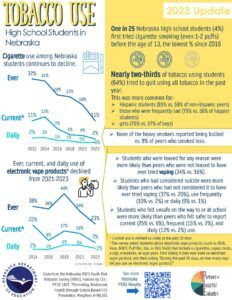
The Youth Risk Behavior Survey (YRBS) is part of the National Youth Risk Behavior Surveillance System, created and managed by the Centers for Disease Control and Prevention (CDC).
This statewide survey is designed to monitor categories of health-related behaviors that contribute to the leading causes of death and disability among youth and adults, including:
- Behaviors that contribute to unintentional injuries and violence
- Alcohol and other drug use
- Tobacco use
- Unhealthy dietary behaviors
- Inadequate physical activity
YRBS also measures the prevalence of obesity, asthma, and other health-related behaviors.
All Nebraska public schools are eligible to participate. In a random sample of schools, students in 9th-12th grade classes are chosen from a random sample within their school and are asked to complete the YRBS. Nebraska has been administered in Nebraska biannually since 1991. Nebraska YRBS data results can also be found in the 2023 Nebraska Adolescent Report.
The bottom line: there are no safe tobacco products, including nicotine pouches. This is especially true for youth, young adults, and people who are pregnant. The CDC developed a webpage with information about what nicotine pouches are, who uses them, and the health effects of using nicotine pouches.
Detroit City Council Approves Ordinance Prohibiting Smokeless Tobacco Use in City Stadiums
Comerica Park Will be 18th MLB Stadium to be Completely Tobacco-Free
Detroit’s professional sports stadiums will soon be completely tobacco-free after the Detroit City Council voted today to ‘Knock Tobacco Out of the Park.’ The Council approved a city ordinance, sponsored by Councilman Fred Durhal III, which prohibits the use of smokeless tobacco products, including nicotine pouches, in the city’s professional sports stadiums.
“We applaud the Detroit City Council for taking action to protect the health of our kids and sending a clear message that baseball and other sports should promote a healthy and active lifestyle, not harmful and addictive tobacco products,” said Kevin O’Flaherty, Associate Vice President, State and Local Advocacy at the Campaign for Tobacco-Free Kids. “Thank you to Councilman Durhal for his leadership on this effort that will protect kids’ health and promote tobacco-free lifestyles.”
A coalition of over 30 organizations supported passage of the policy in Detroit.
Educators’ perspectives on vaping in the classroom: A disruptive, pervasive problem

As students return for a new academic year, educators continue to grapple with nicotine use in schools, reporting that vaping is “a daily issue” that disrupts learning and poses risks to academic performance, according to a new study from Truth Initiative.
The report, which shares findings from focus groups conducted across public, private, and charter schools of various sizes across the country, illuminates the academic and behavioral consequences of vaping at school and the enforcement challenges that teachers face. Educators report that students begin “dabbling” in vaping as early as 6th grade, with use becoming widespread as students enter high school, possibly as a coping mechanism for anxiety, stress, and depression.
Tobacco Free Kids: New Nicotine and Nicotine Pouch Fact Sheets
The Campaign for Tobacco Free Kids has released new fact sheets on the health effects of nicotine and nicotine pouches, in light of the rising popularity of nicotine pouches and other tobacco products.
View the new fact sheets here:
Beyond Addiction: The Health Effects of Nicotine
Increased Popularity of Nicotine Pouches Raises Concerns About Impact on Young People
Monitoring E-Cigarette Use Among Youth – Updated Nicotine Pouch Sales Data Through August 2025

On October 10, the CDC Foundation’s website was updated to include nicotine pouch sales data through August 2025. You can find the data brief here: Nicotine Pouch Sales Data & Trends in the United States – Tobacco Monitoring. It provides national data, as well as data for California, Massachusetts, New York, and Rhode Island.
Key findings include:
In Massachusetts and California, sales are dominated by products marketed as “smooth/original.” In states that do not restrict the sale of flavored nicotine pouches, mint and all other flavors (e.g., fruit, candy, drinks) are the most commonly sold flavors
Total monthly nicotine pouch sales increased by 250.8% between January 2023 and August 2025.
Few nicotine pouches sold in the United States are tobacco-flavored. As of August 2025, mint flavor accounts for 60.5% of sales, followed by other flavors (e.g., fruits, candy, drinks) at 23.6% and flavors marketed as smooth/original at 10.5%.
Tobacco Product Use and Type by Military Veteran Status: Findings from the National Health Interview Survey, 2021–2023
Tobacco use is common among United States Veterans; however, most research is a decade old, does not examine the range of tobacco products, nor consider the role of Veteran-specific factors (eg, Veterans Health Administration [VHA] health insurance).
A Nicotine & Tobacco Research analysis of National Health Interview Survey concluded that veterans (7.9% of the sample) had higher odds of all current and former tobacco outcomes, with the highest adjusted odds ratios for current use of cigars, pipes, polytobacco use, and cigarettes, compared to non-veterans.
Adolescent tobacco and nicotine prevention: Opportunities missed in the dental office
Despite declining rates of adolescent cigarette smoking, emerging products continue to pose a threat to youth. Oral health care professionals, who often see adolescents more frequently than other clinicians, are uniquely positioned to intervene.
Data (N = 3,898 survey responses) were analyzed from the 2023 Florida Youth Tobacco Survey, a statewide, school-based assessment of tobacco behaviors. Additional analyses focused on high school students who reported a dental visit in the previous 12 months (n = 2,835). The Rao-Scott χ2 test was used to examine whether the proportion of students who visited a dentist’s office in the past 12 months differed by demographic characteristics. Logistic regression models were used to evaluate associations between demographic factors, electronic cigarette (e-cigarette) use, and reported discussion about the dangers of tobacco in dental settings.
Although more than 70% of high school students visited a dental office within the past year, only 13.1% reported being told about tobacco dangers by dental personnel. No significant (P > .05) associations by demographics were found for tobacco-related discussions. However, Hispanic students had lower odds than non-Hispanic White students of reporting receiving e-cigarette discussion, even after adjustment for e-cigarette use.
FDA Updates
- On September 25, 2025, the FDA posted new materials related to the modified risk tobacco product (MRTP) renewal applications submitted by Philip Morris Products S.A. for several IQOS heated tobacco products. The documents are available on the Philip Morris MRTP application webpage.
- As part of the FDA’s broader strategy to combat the crisis of youth vaping, the FDA is launching an initiative to increase voluntary compliance from retailers—including vape shops, convenience stores and gas stations—that play a key role in the distribution of both legal and illegal products into American communities.
- New Wave 7 Biomarker Restricted-Use Files from the Population Assessment of Tobacco and Health (PATH) Study are now available from FDA’s Center for Tobacco Products and NIH’s National Institute on Drug Abuse.

Resource of the Month
Quit Tobacco Week Media Kit

Tobacco Free Nebraska, the Nebraska Tobacco Quitline, the American Cancer Society, and other partners across Nebraska are teaming up to promote Quit Tobacco Week, November 16-22, 2025, and the Great American Smokeout on November 20. The purpose of the week is to encourage Nebraskans to quit tobacco for good and to celebrate people who have quit. This week provides an opportunity for outreach to healthcare providers and planning events to encourage Nebraskans to quit tobacco.
Tobacco Free Nebraska has FREE resources available to help your organization celebrate Quit Tobacco Week:
- Swiss Cheese press release – a prewritten press release with blanks to enter your organization’s information and copy/paste onto your organization’s letterhead
- Quit Tobacco Week social media posts – prewritten social media posts and graphics
- Nebraska Quitline Quitline Order Form – QuitNow.ne.gov/QuitlineOrderForm
- Continuing Education Credits about tobacco cessation – QuitNow.ne.gov/providers
- Small (~17″ tall) and large (~60″ tall) “Ready. Set. Quit.” pull-up banners
- “Living with Cancer” or “Living with Diabetes” notebooks with pens
- Tobacco Cessation – What You Need to Know Permafold
- Quit Smoking Tips and Cost Calculators
To order any resources, please email dhhs.tfn@nebraska.gov. There are a limited number of banners, notebooks, and cost calculators.

Julia C.
Julia comes from a large and loving Mississippi family who came to her aid when she nearly died at age 49. Julia smoked for more than 20 years and developed colon cancer, which is a danger for all people who smoke. When her symptoms first started—cramps, diarrhea, and vomiting—she was puzzled and tried to manage them on her own. Then one day, the pain and bloating got much, much worse. A colon exam revealed that her intestines were completely blocked, which can be life threatening.
“I will never forget that day. I was so sick. They found the tumor in my colon and rushed me to the hospital,” said Julia. She had surgery and then months of chemotherapy to treat the cancer. She needed an ostomy bag taped to a hole in her abdomen to collect waste. Julia’s family took care of her and her young son, who was terrified to see his mother so sick.
“The sickness really opened my eyes,” said Julia. “By smoking, I was damaging myself and the people around me. I’m so glad I quit!”